
The Dance of the Elephants.
Researcher have now made it fairly clear the thinking part of our brain (the part that reads and understands this text) doesn’t really make our decisions. It thinks it does, but the emotional parts of our brain are in actually charge. What does this mean for our relationships and conversations? What happens when our emotional brains interact (which they do all the time).
Two Conversations Learning about our internal process in dialog. (Blue Brain and Red Brain)
Our brain has different several parts which process separately and semi-independently. Caveat – this is a very basic model of what happens.
- I am not a neuroscientist! (if you are, my apologies in advance
- One can take an advanced degree in studying this subject
- AND… I have found this simple model is quite revealing and incredibly useful.
-
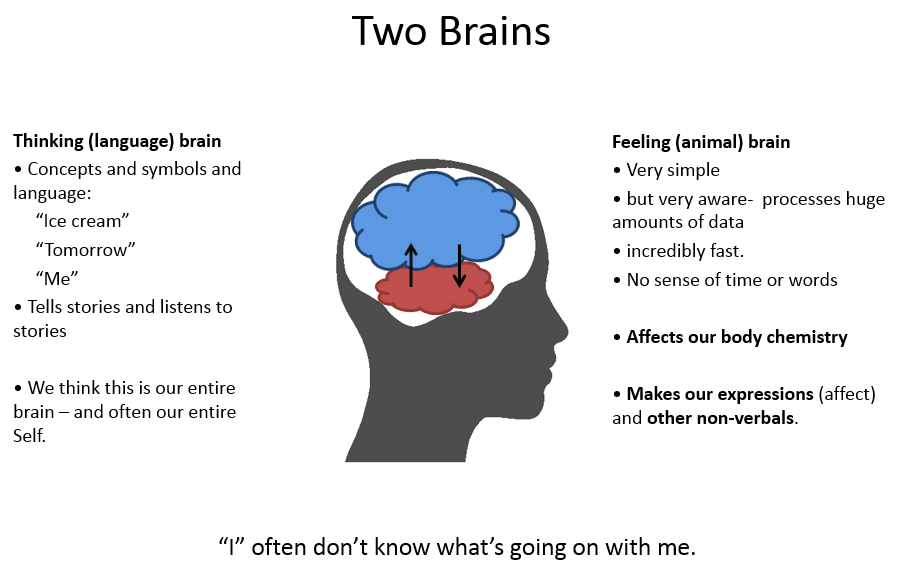
Cognitive, thinking, or language brain (blue brain)
- Makes symbols, concepts and can hold them as thoughts. Such as:
- sushi, or ice cream, or pizza
- “Kevin” or “Campbell” or “Mom.”
- tomorrow or yesterday
- words – this is our language brain
- Me. This is my concept of myself. Right now blue brain is writing about both brains
- Powerful but relatively slow and massively simplifies the world. A good example is labels.
-
Emotional, intuitive, animal brain (red brain)
- All the brain parts that are not blue brain. It extends into our body.
- Runs our physiology (heart rate, etc) electrically and chemically
- Very fast and processes lots of information at once
- Responds to stimuli the other brain misses.
- Subliminal messages in videos – blue brain doesn’t notice but heart rate jumps
- Operates by conditioning and habit and conditioning, not symbols and logic. Pattern recognition. Pavlov’s brain. Jung’s unconscious brain.
- Seat of all our feelings and emotions and intuitions.
- makes our decisions. We cannot make decisions if it is injured.
-
They work together… sort of
- Red brain triggers us, floods us, and hijacks us. Blue brain can override it, but blue brain gets tired a lot sooner.
- We can influence red brain by thoughts and actions
- soothe red brain (deep breath) or agitate it
- speaking out – naming what we feel
- Red brain likes to be heard. Noticing our feelings puts us back in charge.
- Red brain is typically quick to react but slow to calm.
-
This is your brains in conversation
- These brains work together but separately. They influence each other.
- Example: Imagine a loud bang outside
- Blue brain processes and thinks, “Wow, that was a loud bang. What happened? Is everything ok?”
- Even before the first thought “wow, that was…” red brain has already processed and reacted in measurable ways:
- my muscles have flinched. heart rate jumps
- released adrenalin into my blood
- and my facial muscles have moved.
These expressions:- correspond to my feelings
- are the same for all humans
- may be subtle and very brief but are observable
- Blue brain may now notice, “Wow my heart is pounding. I feel scared. I remember now workers are building across the street, and have made a few bangs.” This thought happens in a moment.
- Red brain may now start to relax, and the body may observably shift. The physiological effects of the triggering stimulus take time to wind down.
- This part is really, really cool (and a bit scary and humbling):
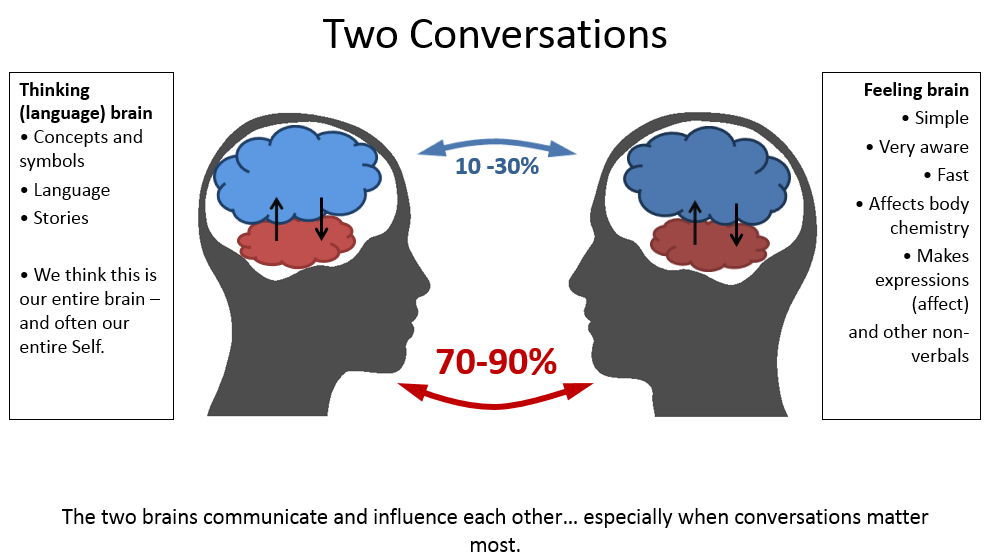
If something in our conversation triggers me like that loud bang, I will non-verbally display that reaction, and your red brain will detect it and react with it’s own immediate nonverbal responses. Our emotional brains have their own conversation.
They can get into positive or negative feedback loops (resonance). - Red brain also has resonance with blue brain.
-
What does means in dialogue:
THERE ARE TWO CONVERSATIONS IN THE ROOM.
- Both brains are transmitting and receiving
- Blue brain only gets one of these channels. Blue brain can’t even follow the other channel, any more than you can walk by thinking through it.
- I want to be in the whole conversation, so I have to become aware of red brain. My red brain is where I receive your red brain. I have to quiet blue brain to hear red brain — tuning into senses is a way to do that.
- You may see more of my red brain than I do (JoHari’s Window).
- How to work with the red brain. Self-soothing and self-regulating
Maybe ADD
The power of Authenticity and congruence. When red brain and blue brain are in sync.
———————————————
Draft longer version winter 15/16
This article has 3 parts:
- Why emotional brains matter: They pretty much make all our decisions.
- Getting to know our emotional and rational brains: Meet Red Brain and Blue Brain [note this has nothing to do with politics].
- Getting to know the emotional conversation and becoming more skilled in it: Red brain to red brain resonance.
In recent years researchers have confirmed how the emotional parts of the human brain dominate our decision-making. Applications of these insights have become widespread, from cognitive behavioral therapy to behavioral finance. But one can trace their study and practice throughout our history, to Madison Avenue advertisers, snake oil salesmen, radio demagogues, yellow journalists, novelists, and our most ancient philosophers.
This article explores how our “emotional brain” engages with the emotional brains of others. These dynamics are a fundamental part of our conversations, our interpersonal influence, our relationships, and even teamwork and leadership.
Our emotional brains are always in conversation with one another. This is continuous, instantaneous, and effortless. Our thinking brains are only partly aware of this conversation because it is mostly non-verbal and often completely separate from the verbal dialog. The more important the conversation or the relationship, the more powerful this emotional conversation becomes, and the more it influences what happens.
In fact, this emotional level of conversation runs our lives. It is where the deal gets closed. It is where we influence our co-workers. It is where we get the job or win the promotion. It is the very core of our friendships, romances, and family relationships. And with a little bit of awareness and practice, we can harness its power to our benefit, and the benefit of those we love and the groups to which we belong.
Part 1. Why your emotional brain matters, or The Rider on the Elephant.
It is now well-established now that our brain has multiple parts which often function quite independently. As one researcher described it, the human brain is built like a very old house which had multiple additions over time. Our cognitive brain is the latest wing, and in many ways the most remarkable. Our thinking brain can hold symbols and concepts. It can process them with logic. And it can communicate them to others through language.
However, our thinking brain doesn’t make our decisions. It thinks it does, but that is mistaken. The emotional brain actually makes most of our decisions, with profound effects upon our lives. This is confirmed by modern neuroscience and psychology (and if you’ve ever tried a diet, by your own experience!).
Psychologist Jonathan Haidt describes our rational and emotional brains as a rider on an elephant. The rider can influence and even herd the elephant, but when the elephant wants to do something the rider has no choice.
This relationship is also described well by the journalist Stephen Dubner interviewing advertising executive Rory Sutherland:
DUBNER: Indeed, the more you learn about behavioral research, the less confident you are that we ever use reason when making decisions. It’s almost as if our reason lies dormant most of the time, allowing emotions to rule the day – our desires and fears, our insecurities and avarice. And if you can learn how to play those emotions in other people, you will have a much easier time of it, whether you’re trying to sell them a newspaper subscription or persuade them to do something a bit more important. Now, we should make clear that this behavioral understanding of human nature is hardly new. Shakespeare understood it. The Book of Proverbs, to name just one book of antiquity, is full of it. But, like all universal truths, the quirks of human decision-making is constantly getting rediscovered and, importantly, codified. That’s what’s been happening in academic psychology and economics lately – the codification of these behavioral anomalies, established with empirical evidence. But as Rory Sutherland makes clear, the academics are late to the game.
SUTHERLAND: Quite a lot of what’s been developed by behavioral scientists over the last 20 or 30 years was discovered by craftsmen in the advertising industry 40, 50, 60 years ago.
DUBNER:And it’s the part that does the deciding that advertisers want to reach. Sutherland here subscribes to the theories of Daniel Kahneman, the author of Thinking, Fast and Slow, who suggests the brain engages in two distinct kinds of thinking: System 1 and System 2, Kahneman calls them.
SUTHERLAND: System 1 can’t talk. It doesn’t seek to influence our behavior by the generation of argument or reason, it simply generates emotions directly. Fear, pain, heat, you know, anxiety, etc. It’s a much faster and more efficient way of keeping us alive.
DUBNER:System 2 is slower, more deliberative. It tries to interpret what System 1 is feeling, but doesn’t do a very good job.
SUTHERLAND: We’re very, very bad at explaining the reasons behind our emotions. There’s a wonderful phrase, which is the talking part of the brain thinks it’s the Oval Office when a lot of the times it’s really the press office. What it’s not really doing is actually coming up with good explanations. It’s actually hastily cobbling together a plausible sounding rationalization for a decision that was actually taken somewhere else, which is what a press office mostly does.http://freakonomics.com/2015/02/26/the-maddest-men-of-all-full-transcript/
Part 2. Getting to know Red Brain and Blue Brain.
For simplicity, I’m going to call our emotional brain Red Brain (because it’s red on the diagram below), and our analytic brain Blue brain.
Working with red brain.
- emotions – can’t fight them.Self-soothing
- Triggers, impulses, and flooding
- What the heck am I feeling?
- reactions, values, and intentions.
- Intuition vs. emotions.
Here is the key part:
Red brain drives micro-expressions and micro non-verbal communications. It also notices and reacts to micro expressions and micro non-verbals. This creates a loop, where one brain signals another and the other reacts, which the first brain notices, … this is red brain resonance.
What does the red brain conversation look like?
Copyright G.C. Frank 2014
 Elephants and Economics